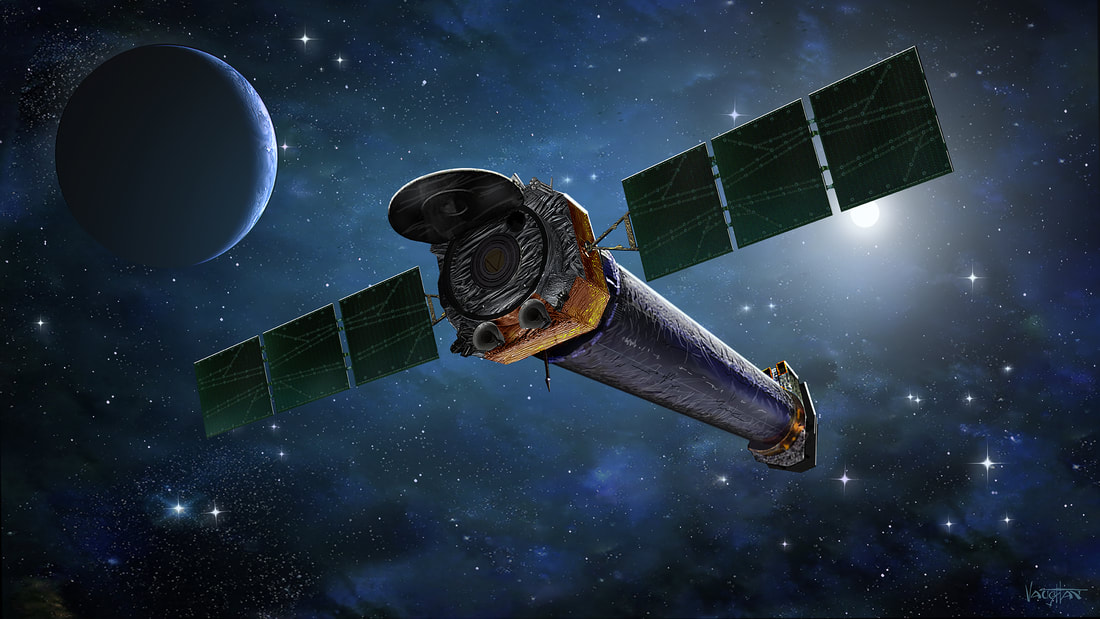
 https://www.nasa.gov/mission_pages/chandra/astronomy/index.html Ranging from the countless theories of physics to simply jaw-dropping celestial objects such as UY Scuti, space is a vast topic that fascinates adults and children alike… Chandra X-Ray Observatory by Aishani Banerjee, 8 Hadid Main sources of information: Google Search, Google Maps, Calculator, Unit Conversion NASA’s Chandra Observatory - named after Indian-American astrophysicist and mathematician Subhramanyan Chandrasekhar, is the world’s most powerful X-Ray telescope. Being a staggering 1 billion times more powerful than the Apollo Telescope Mount (the first X-Ray telescope), scientists suggest that if this improvement rate is constant then we may be able to witness the formation of the universe soon! You may wonder how this is possible - the answer being that the light takes time to travel such great distances (therefore, if we stare at a celestial object that is located 5 light-years away, the events we see have already occurred 5 years ago). Sources claim that the advanced telescope can already study quasars from 10 billion years ago, whilst the Big Bang materialised during an estimated 13.8 billion years ago. If large, detailed descriptions bore the sweat out of you, then feel free to read these fun facts about the renowned satellite and X-Ray telescope! Don’t worry, it isn’t rocket science! 1) Black holes are known to have a horrifyingly strong gravitational force which is inescapable once an object gets sucked by it, however the Chandra Telescope is able to observe these objects during the last millisecond before they vanish into the hole of doom. 2) Chandra flies approximately 100 times higher than the Hubble Space Telescope (a famous astronomical observatory launched in 1990). Chandra's orbit height is 105,312 km. 3) The dirt on the Chandra mirrors is equivalent to only one speck of dust on your computer screen, making it 99.999% clean. 4) The Chandra mirrors were coated a micro inch (μin) thick with iridium - a quite rare, corrosion-resistant metal more reflective than gold. 1 kilogram of this silver metal costs £130,000! 5) Chandra's maximum speed is a supersonic 4.7 km/s; which means that it can travel to New Delhi (7,775 km) in only 27 minutes and 38 seconds whilst usual passenger aircrafts take 10 hours!  6) During mid-2017, the total cost of this space shuttle after years of development and operations was around £2.95 billion. 7) If the State of Colorado were as smooth as the surface of the Chandra mirrors, the 4.302 km high summit 'Pikes Peak' would be less than an inch tall (300 million times flatter). 8) Chandra will observe X-Rays from vast, gaseous clouds with diameters as long as several million light years! These contain enough matter to create hundreds of trillions of stars! I hope you have enjoyed reading about this topic! GLOSSARY: Atomic Number: The number of protons in the nucleus of an atom. Big Bang: A theory explaining how the universe, time and matter came into existence. Celestial Object: An object in space E.G. The Sun. Chandra X-Ray Observatory: The world’s most powerful X-Ray telescope. Corrosion: The gradual destruction of metals by chemicals in the atmosphere. Electromagnetic Radiation: The flow of energy at the universal lightspeed that makes up radio waves, visible light, infrared rays etc. Iridium: A quite rare, corrosion-resistant metal with an atomic number of 77. Light-year: The distance light travels in one year (9.5 trillion kilometres). Micro inch: One millionth of an inch (μin).
New Delhi: The capital city of India (the 2nd most populated country in the world). Photon: A tiny particle of light or electromagnetic radiation. Quasar: A luminous galactic region powered by a massive black hole at the centre of a galaxy that produces an extremely large amount of radiation. Space Shuttle: A reusable spacecraft designed to transport people and cargo between earth and space. State of Colorado: A mountainous, western U.S. state. Subhramanyan Chandrasekhar: The name of a Nobel prize-winning, Late Indian-American astrophysicist and mathematician. Summit: The peak of a mountain. Supersonic: When an object exceeds the speed of sound (340 m/s). UY Scuti: The largest star in the universe - a red hypergiant star with a diameter of 2.4 billion kilometres. X-Ray Telescope: An instrument used to collect photons from high altitudes outside Earth’s atmosphere.
0 Comments
Leave a Reply. |